|
|
Engineezy is an engineering creator specializing in mechanical and mechatronic builds, including marble machines, robotic systems, kinetic sculptures, and experimental contraptions. Created by Jay Vogler, Engineezy’s website and social channels have become a go-to for makers and general audiences, combining creative design projects with design humor and visual appeal. Vogler was also a keynote speaker at 3DEXPERIENCE World 2026.
A recent Engineezy project focuses on a specific mechanical challenge: creating a system that draws a perfect square using a single motor in continuous motion. Previously, Engineezy successfully developed a mechanism for drawing perfect circles.
Drawing a square with sharp corners is more complex. Turning the paper can be unreliable and imprecise, causing the corners to drift and leading to accumulated errors. The mechanism needed to automatically draw a square with clean 90° corners using just one motor, without stopping or requiring any。
The First Pass
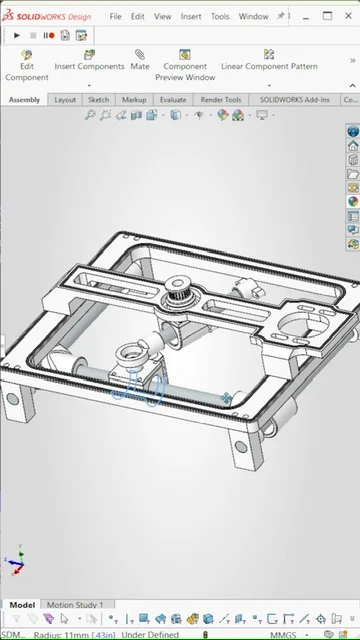
The initial design was built in CAD using SOLIDWORKS. It relied on a motor driving a slider, which connected to a second slider capable of moving along two axes. It looked like a solid CAD design. But when the design was printed and run, the mechanism appeared to draw a circle again, only more complexly. Without elastic tension, the system still followed smooth, continuous motion, which naturally leads to curved paths.
Fixing the Constraint
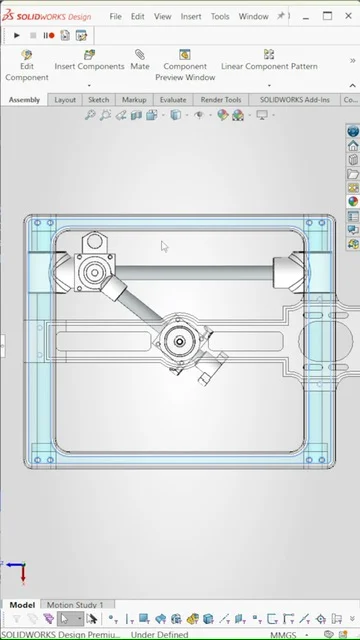
The next revision addressed a constraint issue. The original cross-slider used a circular rod, which allowed slight rotation within the assembly. Under load, that freedom introduced misalignment and caused binding. Replacing the circular rod with a linear rail removed the extra degree of freedom. Motion was restricted to a single axis, and the mechanism could run without binding.
What Forces the Corners?
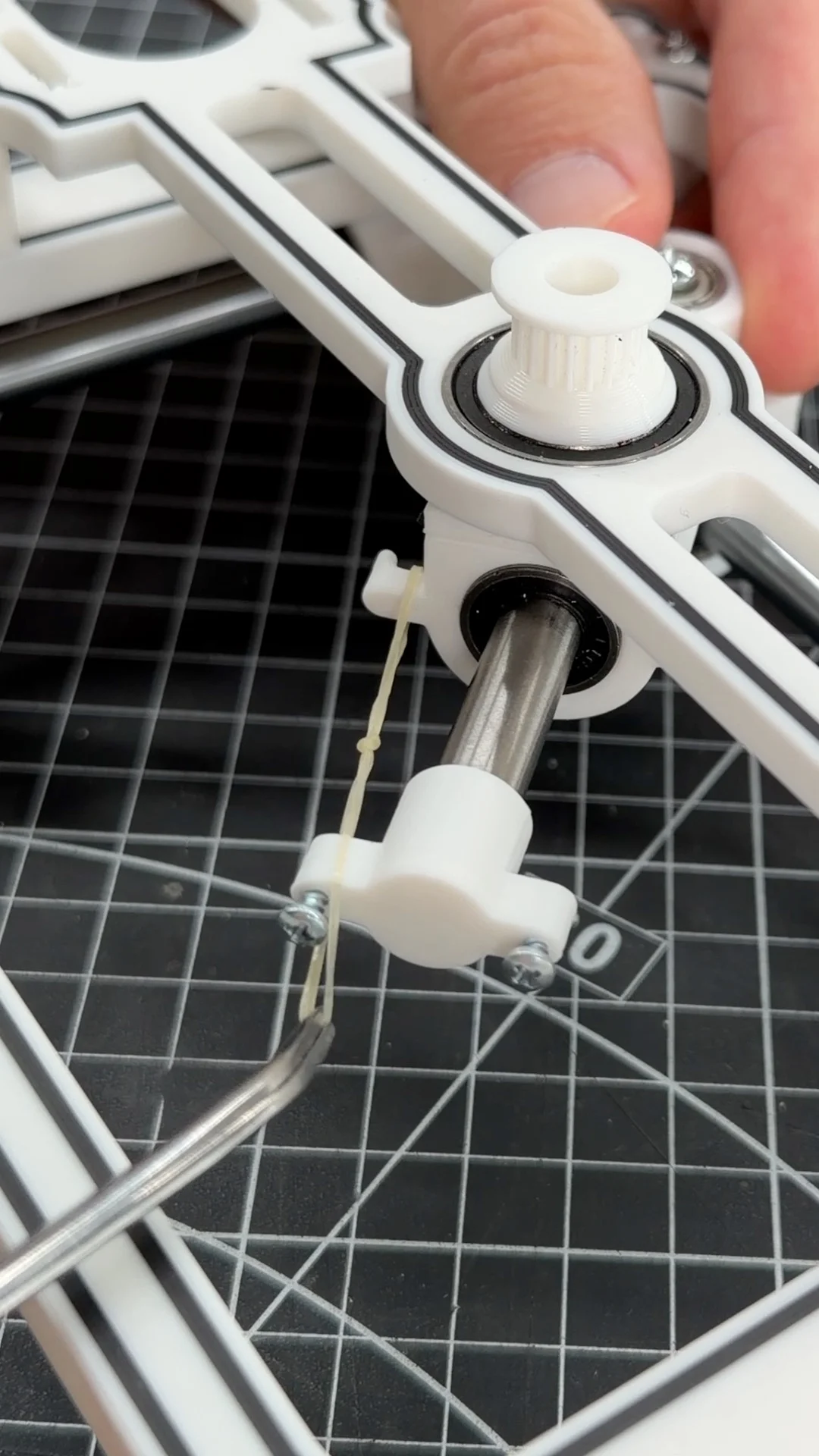
With alignment resolved, the remaining challenge was producing sharp corners. A rotating system does not create abrupt directional changes on its own. In this case, the transition comes from elastic tension. As the motor drives the slider, elastics pull the carriage toward the limits of its travel along each axis. When the carriage reaches one of these limits, the tension forces an immediate change in direction. Instead of continuing through a curve, the motion shifts at the extremes, forming distinct 90-degree corners.
Final build
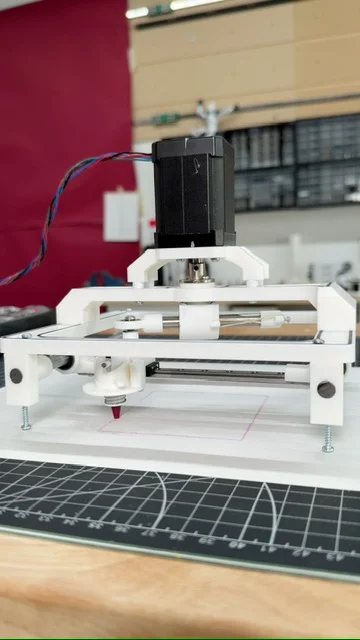
The entire mechanism was designed in CAD with SOLIDWORKS for Makers. It operates on a single motor and includes a latch that controls when the pen engages with the surface. Once running, it continuously traces a square with consistent edges and corners.
Key learnings from the project:
Continuous rotation produces curves unless motion is tightly constrained.
Small freedoms in a mechanism can lead to failure under load.
Sharp corners can be achieved through force limits rather than by adding control systems.
CAD plays a direct role in resolving these issues before parts are built.
|
|
 |小黑屋|手机版|Archiver|机械荟萃山庄
( 辽ICP备16011317号-1 )
|小黑屋|手机版|Archiver|机械荟萃山庄
( 辽ICP备16011317号-1 )


 发表于 2026-6-24 12:16:49